Showing posts with label writing. Show all posts

Friday, September 30, 2016

A bit of characterization advice: the ideal self

Sometimes my time wasting habits are validated. In this case, my time spent on Reddit furnished some enlightening (or at least intriguing advice).

I've complained before about how I never felt like my formal education taught me about good prose but almost nothing about good stories. So when I find advice in that vein that actually clicks with me (like Orson Scott Card's M.I.C.E. model of plotting) I get pretty excited about it. The same goes for characterization. The character-building exercise that sticks in my mind most clearly is the one I remember as the least useful: "What are ten things your character would have in their pockets?" That's a question that might tell you something about your character, but rarely the sort of things that drive a character-based story--at least, not the kind of story I'm interested in writing.

I think I've gotten better about writing active characters. (In college, I wrote one story about a high school student who did nothing but observe the people around him, and at the very end of the story, punched a locker and cursed.) But I know I'm not the only writer who's still vexed by a need, pointed out by the occasional beta reader, to make a character more "likable."

Maybe it's because I grew up watching Seinfeld instead of Friends (although I still like the schmucks on Seinfeld better than the schlemiels on Friends). Anyway. Everyone "knows" that you need likable characters, and maybe Seinfeld is the exception in the perennially misapplied axiom. And getting people to like your characters sometimes seems as confounding as getting them to like yourself.

In response to a question on /r/writing, Redditor Lon-Abel-Kelly made a straightforward observation on creating likable characters that I can't recall seeing before:
Have some idea of their ideal selves. Who they would wish to be if not for circumstance and personality flaws...
You should like the ideal selves, they should be great company... You should sympathize with the ways they fail and self sabotage and you should be endeared by the little ticks of progress.
There was more, but that was what jumped out at me. If you can like who a character wants to be, you can like the character. If nothing else, it's easier to find people who aspire to goodness than who achieve it to an impartial observer's satisfaction. It's also easier in fiction than in real life to show someone who a character wants to become.

The idea of a likable ideal self rings true when I check it against successfully written characters. Many, many protagonists start of wanting to be heroes, to be brave and competent, and yet spend a surprising amount of their stories being bad at these things.

Looking at a character through this lens also exposes the whole space between who they are and who they want to be as a field for conflict and achievement within the story. When they grow, it has value. When they fall short, it's a tragedy we can share with them instead of just another reason not to like them.

This is, of course, assuming that the character wants to be someone you would like. If you know a character aspires to something that a reader will detest, well that opens up new horizons for creating unsympathetic characters. (Or does it? Kylo Ren in the latest Star Wars wants nothing so much as to be like Darth Vader, and that's so misguided and sad that he ends up sympathetic again. But maybe that's so relatable because, deep down, we all want to be Darth Vader, and the tragedy is that we shouldn't.*)

At any rate, this is a perspective I'm definitely using as I flesh out the characters in my current project, which is just at that stage where personalities and events are starting to inform each other.

* And I told myself I wasn't going to use Star Wars as an example. I was going to bring up Luke Skywalker earlier but no, I told myself, you can do better.

Sunday, July 5, 2015

Writing, advantages, and the myth of Athena

Rather than being born and growing, the goddess Athena was said to have emerged out of Zeus' forehead, fully grown and fully clothed, too. Writers have been trying to recreate Zeus' workflow ever since.

Or, at least, writers have a frustrating habit of doing actual work and then lying about it. (c.f. Coleridge and the poem "Kubla Khan," supposedly conceived full-formed in a dream). This is part of what got us creatives into the mess I was complaining about last month, where the general public is loath to pay for art that they think came about effortlessly.

It's not just economics that makes it a good idea to acknowledge the realities of writing--that is, it's not just audiences who need to be set straight. People who want to create suffer from the popular image of art as something that just sort of happens to creative people. (There's similar harm done by the idea that to be an artist it's necessary to be crazy or dysfunctional.) What work, exactly, I am trying to do and how, exactly, to do it, is something I'm still getting a handle on, myself.

What brought me back to the topic is a pair of articles I stumbled on today. One is a book excerpt by Matthew Weiner, the major creative force behind the recently ended series Mad Men. I'll just quote what he says on the matter right here:
Artists frequently hide the steps that lead to their masterpieces. They want their work and their career to be shrouded in the mystery that it all came out at once. It’s called hiding the brushstrokes, and those who do it are doing a disservice to people who admire their work and seek to emulate them. If you don’t get to see the notes, the rewrites, and the steps, it’s easy to look at a finished product and be under the illusion that it just came pouring out of someone’s head like that. People who are young, or still struggling, can get easily discouraged, because they can’t do it like they thought it was done. An artwork is a finished product, and it should be, but I always swore to myself that I would not hide my brushstrokes.
Much of his story of the path to success is the usual one about persisting in the face of discouragement and rejection, but he also mentions being married to an architect who was willing to support him during his years of frustration. I think more people who extol the virtue of persistence should be up-front about how they ate while they were persisting. Which brings me to the second article I stumbled on (with the help of my wife--just one of many things she helps me with is stumbling on interesting writing) by author Ann Bauer, saying authors should be less coy about where their money comes from (at least, as is often the case, when it comes from family or spouses). Even Virginia Woolf said that if you're going to write fiction, you need some money (and a room of your own) first.

It's disheartening to imagine that people who succeed do so because of money or connections, but then that's not the entire truth, either. I suspect that the real secret to success (and a secret because, unlike, say, luck or hard work, we rarely discuss it) is to figure out what advantages you have and make the most of them. The right combination probably isn't the same for everyone. But aspirants should stop feeling like failures for relying on their support networks just because their heroes forgot to mention the time they spent doing the same.

Sunday, June 7, 2015

Showing your work

There's a question I've been meaning to raise for a while, but I've put it off because I couldn't suggest an answer. Then in last week's post, I sort of stumbled on a partial answer, so I'll go ahead and raise the question.

With the advent of internet celebrity and, perhaps, the "maker revolution," there seems to me to be a trend toward audiences wanting to see the work that goes into art. I first noticed this when my sister introduced me to the music duo Pomplamoose. Specifically, she showed me this video:
 

Pomplamoose's videos are brilliant, but they are the opposite of "slick" (meaning, in this case, apparently effortless, hiding the mechanisms behind the finished product). In fact they go out of their way to make sure you understand what they're doing so you can appreciate it.* You can see the same idea at work in their "video song" music videos, where they scrupulously show you the origin of all the sounds they use in the song:
 
I know that music like this tended to be a sort of blur to me: whole instrumental tracks could play without me realizing I was hearing them. I imagine lots of people experience music similarly. Playing Guitar Hero 2 was a revelation for me, and after that I started being able to tease out the lead, rhythm, and bass guitar parts in songs I was listening to. By the same token, I can hear more going on in Pomplamoose's songs because they signaled for me to listen for them.

So musicians can show the components of their songs. Visual artists can record videos of their progress for fans. I had trouble figuring out how writers could take advantage of the same phenomenon. Surely no one would want to watch me write live--it would be sort of like reading a finished piece, except only a few words would appear every minute.

Neil Gaiman has at least a partial solution, I realized. Like I talked about last week, his writing lets the reader see his work of recombining familiar elements. It brings readers closer to the actual process of writing, which is more about arranging ideas than simply having them. It dispels the hazardous myth that writers just conceive their ideas in perfect completeness and then write them down (a process which I suspect many people imagine takes no more time than reading).

I shouldn't be resentful, but the art-as-magic myth doesn't do anyone any favors. As my friend Elinor Diamond pointed out recently, writing is work. The writers of yesteryear worked hard to give the impression that they weren't working hard. Some of them flat-out lied about their writing process in order to make themselves seem like some sort of word-wizards.

The dynamics are changing, and wizardry doesn't pay anymore. The process is becoming part of the product. I'm sure there's more to this puzzle than I have figured out.

* Even in their more out-there videos, they eschew a reaction of "how did they do that?" in favor of a "I can't believe they did that."

Sunday, May 17, 2015

How much does your writing weigh?

Microsoft Word and some other programs have a useful feature that will take your writing and tell you its Flesch-Kincaid reading level. At least, this information is useful if you have some idea what it is. Briefly, the Flesch-Kincaid grade level formula is supposed to take a bunch of writing tell you about how many years of education you would need to make sense of it. It goes like this:
0.39 (number of words/number of sentences) + 11.8 (number of syllables/number of words) - 15.59
Before I get to my point, let me talk about cars. Since I know hardly anything about cars, I can promise this won't take long.

Some cars are much heavier than others. Now, engineers generally try to make their cars as light as possible so they can go faster, so one reason a car might weigh more than another car is that it's not as good as the lighter car--the engineer made bad choices, the factory used lousy materials, and such. But a lot of very well-made, very fast cars also weigh a lot. Why? Because they have powerful engines, and more powerful engines are heavier. But even in a car with a powerful engine, the engineers will want to keep the weight of the rest of the vehicle down.

Back to writing. What I've discovered is that the idea you're trying to get across is like your writing's engine. Reading level makes a good, rough indicator of your writing's weight. Sometimes big ideas take big words to get across, and complex ideas take complex sentences. There's not necessarily any shame in a higher reading level. But make sure it's because of what your writing has under the hood, and not because you filled the backseat with scrap metal.

Here's a passage, for example, that weighs in at a 12.7 grade level. That means, in theory, that if you haven't graduated high school you probably won't be able to follow it:
When we wish to correct with advantage, and to show another that he errs, we must notice from what side he views the matter, for on that side it is usually true, and admit that truth to him, but reveal to him the side on which it is false. He is satisfied with that, for he sees that he was not mistaken, and that he only failed to see all sides. (Blaise Pascal)
In this case Pascal had a few things to say. Every clause adds something to the sentence in (more or less) as few words as necessary. A modern writer might throw the reader a bone and break the sentences up more, but a 12.7 grade level is forgivable.

Now, on the other hand, take something I wrote to see if I could:
I assert that it was my own personal experience and is now my very highly confident and very considered opinion that the phenomenon was, overall, very highly negative and undesirable in all or at least the substantial majority of its effects, consequences, aesthetic qualities, moral components, and/or the subjective emotional feelings which it directly or indirectly brought about and/or produced in myself and/or in others who shared the same or similar or related experience of events which had related and/or directly or indirectly comparable characteristics.
According to Word, the Flesch-Kincaid grade level of that sentence is 41.3.* And let us be clear: it does not actually take 17.3 years of post-doctoral education to decipher this monstrosity. It certainly didn't take that for me to write it. I would argue that to have one's eyes glaze over is to truly comprehend the passage. It is a mockery of a sentence, not (simply) because of its length, but because it is a paraphrase of the sentence: "I thought it was bad."

Writing clearly is harder than writing obtusely. Writing clearly is also better than writing obtusely--there isn't much I'm more sure of than that when it comes to writing. Yet at some point (high school? college?) we seem to learn to "up-write" and use weighty writing to create the illusion of weighty ideas. If we're lucky, we learn to un-learn that lesson before we waste too much effort before it becomes an intractable habit.

* I started out aiming as high as I could go, thinking I might hit the high teens. On seeing that I had in fact hit the mid thirties, I thought I would try to get as high as 40. I overshot, and wondered if I could perhaps squeeze out 50 without adding anything of value. I'm sure I could, too, if I wanted to spend another half hour at it, but really it's better to call it off here.

Sunday, May 10, 2015

The Last Ringbearer: or, playing in someone else's sandbox, sort of a review

I recently had the interesting experience of reading The Last Ringbearer, by Kirill Yeskov. If you've read The Lord of the Rings, the name sounds oddly familiar, and it should: The Last Ringbearer is a novel written parallel (or maybe crosswise) to the plot of LOTR, with the central conceit that Tolkien's novel is a "victor's history" written by Gondor's partisans after their successful war against Mordor.*

I can't recommend the book on its own merits**, but I'm not here to rag on it either. If you're a quick reader and the above sounds interesting at all, then do read it***, or at least the first part, which tracks most closely with the events of Tolkien's book.

LRB diverges from LOTR from the first page, and it diverges hard. Beyond the broad category of "fantasy" the books don't even share the same genre: LRB starts out reading something like a Conan yarn, and it evolves into something more like a Cold-War spy thriller. What gives?

I'll tell you what. Because I could complain about the genre shift as "missing the point" of the source material--and other people have--but I think that, itself, is missing the point. In an important way, Yeskov's Middle Earth is strikingly true to Tolkien's Middle Earth.

You see, Tolkien's Middle Earth was a canvas, or perhaps a terrarium, which he filled with linguistics, Norse epics, his experiences in the Great War, and an undercurrent of Catholicism--in short, anything and everything that interested him. Later writers have mistaken Middle Earth for an archetype, and hesitated to deviate from it.

I think Yeskov did what Tolkien did, and filled his version of Middle Earth with whatever the hell he found interesting: rationalism, politics, spycraft, werewolves, parallel universes, and so on. I honestly couldn't tell you whether J.R.R. Tolkien would approve of the result, but I'm pretty sure more fantasy writers could stand to learn a lesson from it.

* Perhaps in the tradition of Jean Rhys's Wide Sargasso Sea, which retells the story of Jane Eyre from a perspective more sympathetic to Bertha Mason.

** It was written in Russian originally, and the English translation is the sort that you have to make allowances for. The plot itself is a little disjointed and, pretty conventional if you sift out the fantasy elements. Yeskov's Middle-Earth amalgam is certainly the most interesting thing about the book. But then, I don't think the book was meant to be sold commercially, and it's free (see next footnote), which softens but doesn't obviate criticism.

*** Because the book is from Russia, and the Tolkien estate is not a fan, the book can't be sold. The e-book, on the other hand, is freely available from the translator.

Tuesday, March 11, 2014

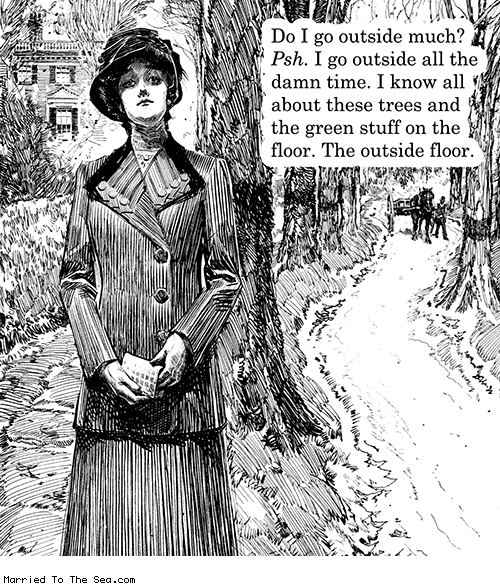
Green stuff and ignorance

(Borrowed from Married to the Sea.)

Just sharing a comic today, which certainly hit on how I feel reading The Lord of the Rings or Watership Down, or other masterpieces by Englishmen who must have spent all their childhoods frolicking in a clearly-labeled countryside. I try not to skim passages that read to me like:
The sweet odour of the smendley mixed with that of new-mown grass, for it was Spring; the curmudgeons bloomed merrily in the hoary elbows of the Mother-Doing-Laundry, and the swips sang amongst the buds upon the branches.
I find myself in a similar position reading The Stand, Stephen King's American epic, except in this case it's cars rather than nature whose names are a dizzying blur. I could care less about cars, but not much less, and I could much more easily care more if I cared to, which I do not.

Not that I begrudge King his interest, any more than I begrudge Tolkien his Shire-y upbringing. It's just interesting to notice the things that a narrator knows by name. Of course a good narrator knows enough to explain what he's on about to ignorami like myself when it's important.* The rest of the time, we can look it up if we need to know.

* We as writers might remember to use the common name of anything that ends up in the foreground of a story. Don't think of it as lowering yourself to the level of your stupidest readers; think of it as expressing the hope that your work will still be read when our household names are but a distant memory.

Monday, February 24, 2014

What do we want? Strong female characters! What do we mean? I'm glad you asked...

How the time goes by. One may justly ask me what I’ve been doing lately instead of blogging. Well, I’ve been watching TV. I’ve been working. I’ve been reading my friend Elinor Diamond’s blog.

I had the neat opportunity to write a guest post for Ms Diamond, and that should be going up today. If you’re interested in some observations of mine on narrative voice and the reader’s place in a story, check it out there.

Meanwhile, Ms Diamond’s recent post opining on “strong female characters” has caused me to start opining in turn.

As she pointed out, the concept of the “strong female character” has drawn some fire lately. Once we started talking about SFCs as something that should exist—perhaps something that writers should be applauded for creating—writers naturally started trying to create SFCs in larger quantities. Yet as a general rule, more people want to be applauded than actually want to do something they find difficult. The result has been a glut of SFC-bait—characters who we’re supposed to appreciate as progressive but who don’t actually do the women of the world any favors.

Part of the problem is people misunderstanding the meaning of “strong.” Maybe it’s not entirely fair to blame them, because when we call for “strong female characters” I don’t think that’s precisely what we mean (I’ll get to that later). But those of us who call for SFCs in media are not (I hope) satisfied with female characters who are merely muscular, merely violent, merely invincible,* merely obnoxious, or who are active when surrounded by minor characters but become passive when they interact with the main (male) cast.

I don’t think we should publicly abandon the idea of the strong female character. It would be a shame if the idea fell out of style without achieving its purpose (or worse, because it had been terminally derailed). But we need to ask some clarifying questions.

People have already been asking what qualifies as a “strong female character.” Precisely, when we demand SFCs in our media, what exactly are we asking for?

I think, as a general rule, what we (I?) really want to see is female characters who shape the story according to their own motivations. That’s what I would call “narrative strength.”**

Some of the better examples from media I’ve recently ingested aren’t exactly egalitarian. Having finished the first season of the new House of Cards, I find Zoe Barnes an interesting liminal case. I actually argued with Girlfriend about whether or not she qualified, but I think if she isn’t an SFC, then the dividing line passes very close to her. I’m going to try to break down the case for her without significant spoilers.

Zoe’s ambition is a major force in the show. Only one other female character competes with her in terms of narrative influence, and in my opinion Zoe is the more influential. She certainly overwhelms the influence of the other characters in her own sphere. It’s only up against Frank, our main character/villain, that she’s clearly in over her head.

That may be the first objection raised against Zoe’s status as an SFC—that the strongest male character in the show exerts so much power over her—but I would argue a key distinction. She doesn’t fade into the woodwork when she shares the screen with Frank—instead, the struggle between Frank and Zoe is one of the main elements of the story. As for her being in over her head, if we respect the characters we write we must allow them to get into trouble. A protagonist certainly needs enough rope to hang themselves with, and Zoe takes her turns as protagonist.

A stronger objection may be the way she works for her goals. She trades on her gender, both offering sex and using gender politics as a bludgeon when one or the other will get her what she wants. It’s not exactly role-model behavior. It’s less of an issue in a show like House of Cards, where the morally uncompromised are a vanishing minority, and a character doesn’t need to be sympathetic to be narratively strong.

Maybe this highlights a shortcoming of the term “strong female character,” though. After all, a media universe filled with “strong” women who trade primarily on their sexuality would be a pretty regressive one, even if those women exerted disproportionate influence on their stories. But the problem of whether we should depict this sort of thing at all turns into two questions, and I’m a little afraid to chase them down because of how long this post is getting already. I’ll make a go of it, though.

The first question: What means can a strong female character use to get what she wants? Must she be a role model? I think girls deserve to see female characters in media who use a variety of empowering means to achieve their goals, but I don’t think media for adults*** can afford to completely ignore that women have certain disadvantages in our society, and a few “dirty tricks” that they can use to get ahead if their goals are bigger than the accepted means at their disposal.

The second question: Are strong female characters descriptive or aspirational? That is, are we showing the world as we see it, or are we showing the world as we want it to be in hopes that life will imitate art? I think the truth for creators is usually a little of both. But what are we asking creators to do when we ask for SFCs? To show us what women can do of in this world, or to show us what women should be able to do in a better one? (How strong a distinction this is is a function of your setting and your worldview.)

As a creator, I think at some point you need to be honest with your characters. They can’t come alive as long as they’re artificially constrained by a lesson we want them to teach. They need to pursue their own goals as they see fit, with the means available to them.

Of course all of this hair-splitting would be less necessary if there were more active female characters in media. We can’t really be honest with characters until we don’t feel the need to make them representative of anything other than themselves.

* Admittedly, we’ve been dealing for centuries with male characters with no personality outside of their proficiency with violence, but writers don’t expect a pat on the head for writing them.

** This isn’t to completely ignore egalitarian portrayals of women—that is, women in traditionally masculine roles: warriors, leaders, any job that usually ends with “-man.” But 1) that’s not exactly the cutting edge of 21st-Century progress, and 2) doing it lazily leads to tokenism. Independent goals and narrative agency are the antidote.

*** If your little girl is watching House of Cards then the portrayal of women in media probably isn’t her biggest obstacle to success.

Tuesday, January 28, 2014

I know something you don't know

If you're like me (and you are) you've had this experience: you find out about something, and then you see it everywhere. This is basically how I ended up learning a lot about web writing this week. I kind of oscillate between thinking of it as having learned something about the craft of web writing, and having learned something about why the internet is awful.

There's a certain style of headline writing that's been taking over the internet. I won't hesitate to compare it to a virus or a fungal blight, because even if the underlying idea is solid, the majority of the execution is terrible. You probably already know what I'm talking about: a hyperbolic, emotion-based claim that doesn't so much indicate an article's content as dare you to prove the headline writer a liar by reading the article in it's entirety. "You Won't Believe..." "Inconceivably Awesome..." "...Will Blow Your Mind." If the internet were truly as rich with such content we would all be quivering husks by now, our every assumption about the world shattered and our relentlessly blown minds a thin paste around the interior edges of our skulls.

Someone has taken it on themselves to make a browser plugin, Downworthy (warning: some language in the link), that changes these stock hyperboles into something more believable. "Literally" thus becomes "Figuratively" and "Will Blow Your Mind" becomes "Might Perhaps Mildly Entertain You For a Moment." I don't think I want to install it myself, because if anyone starts writing headlines like that in earnest I want to give them credit, and not mistake them for the work of my cynical plugin. Besides, Downworthy would only externalize what I already do in my head as I read these things. The point is that stumbling on this plugin was among my first steps down the rabbit hole.

Soon after this (or before, I don't remember--reality is confusing) I found the same style lampooned again, on Cracked.com, of all places. The irony here is that for years I had been thinking of this as "Cracked style," and if they didn't pioneer it they were the first place I saw it. Not to be too judgmental--I could forgive this sort of thing from a humor site. It was only when it caught on elsewhere that it actually became objectionable.

The last piece of the puzzle--I didn't think of it as a puzzle until I saw this--fell into place shortly after I found, through wandering internet happenstance, the following tweet:
In reference to this tweet:
I took a moment to be suitable appalled about it all. But to the point of this post, I hadn't realized we (and by "we" I mean you, CNN) had sunk so low. And more to the point, I had finally given a name to my pain, and it is "curiosity gap."

A name enabled research. Whose bright idea was this? Well, I'm not being scientific about this, but some Googling indicates that the concept originated in behavioral economics courtesy of George Loewenstein in the mid 90s, and entered the marketing vocabulary (which is to say, metastasized) around 2006. The concept itself is innocent enough: people are curious about what you are going to say when you tell them you know something they don't know, and which they thought was unlikely.

Of course the difference between "informing" and "lying" rests mainly on externalities, what's good for telling the truth is good for lying, too. Conversely, the technique isn't evil in and of itself. Manipulative? Maybe, but not necessarily--surprising information exists. Tired, though? Hells yes. At least the way they're driving it right now.

I do believe that knowing the name of something is a sort of power. Now I (and you, too) can recognize this thing. I can conceptualize it. With the proper precautions I may even summon it someday and make it do my bidding. For good, of course.

Thursday, December 5, 2013

How I spent my Thanksgiving vacation

The week of this Thanksgiving I visited my family up in Long Island. It happened to be the final week of NaNoWriMo (or ShoStoWriMo, in my case), with me planning on busing back to Maryland on the 30th, meaning I would have to either hit 50,000 words a day early (unlikely) or cross the finish line in transit. I would be getting home so late that trying to get in a day's writing after I arrived would surely tempt the wrath of the muses, and possibly defy logistics outright.

The day before I left--a day which I had earmarked for a long push in an involved freelance project--my laptop began acting sickly, clicking and stalling and generally toying with the idea of becoming a brick. I was able to do some necessary work in Safe Mode, and then I spent my first day with my parents like this:


I didn't intend this picture to be a selfie when I took it, but there I am. As might be gathered, I was not feeling too great myself at the moment, a heating pad wrapped around my neck like a brace. The bus ride up north was pretty nice as these things went, but it had left me pretty sore and I probably had a cold too.

What my computer is doing in this picture is mostly magic to me, but I did find a way to conceptualize what I think it was doing and explain it to my parents:
Inside my computer lives a cloistered monk, in the medieval style. He sits at his table with a quill and ink, and a massive tome containing all the information on my computer. When I ask my computer to do anything, this monk finds the information I want through a convoluted series of cross-references, or else writes whatever else I want to record wherever he can find enough white space on the nearest page.

In the centuries of computer time that have passed since 2008, this tome has been through a lot. Some of the pages have been marred by water and others by fire. Vandals got in on a few occasions and their additions have been meticulously crossed out. But in all that clutter lately my dutiful monk has spent more time squinting at certain hard-to-decipher passages than he has actually doing what I ask him to do.

So the work my monk is doing here, if I understand the process correctly, is to go through the entire book, from one end to the next, and wherever he finds a page or line that is hard to read, to figure out to his satisfaction what it actually says and then re-write it clearly on the blank pages in the back of the book.
Anyway, that was how I described the process to my parents and to myself, and it made me less likely to rail against fate for how long the process actually took--four or five hours. There's a lot of data in this computer but that monk can scribble pretty fast.

Whether or not I had it right, the process revivified my computer. I still kept the computer in Safe Mode while I worked; I was walking on eggshells. (And if hearing that makes you want to bang your head against the wall, rest assured I suffered for my ignorance... I think. Read on?)

So in the last four days of November I put out almost 15,000 words. Ironically I think these were some of the best words I had gotten down the whole month. My graph, courtesy of Nanowrimo.org, ended up looking like this:

With the highlighted part happening at my parents' house. The days on either side were spent on buses. The day in the middle was Thanksgiving.

It seems a shame not to mention Thanksgiving itself, but the day was not the stuff good stories are made of. My extended family was good company and all the food turned out well. I discovered that my father actually prefers marshmallows on his sweet potatoes, which I had previously dismissed out of hand as a barbaric custom, but beyond that what's to tell?

When I got on the bus to go home and settle in for my final lap of the month's writing, I discovered that the last 10,000 words or so of the project were gone.

Why? I'm not certain. Did they refuse to save because I had been working in Safe Mode? Perhaps, but that doesn't some things that didn't disappear but should have. I don't have a better theory, anyway. Maybe the end of story number 4 and the beginning of story number 5 are still knocking around inside my computer, but they are beyond the reach of my own feeble magics. To adapt an old saw, God and I were both there when I wrote the first draft, but I fear that now God has the only copy.

But I'm taking credit for the words because dammit, I wrote them.

As I said, this was intensely frustrating because I think what I lost consisted of some of the best writing I had done that month, including several thousand words of Robert E. Howard pastiche that felt (I'll probably never know how they stand up to rereading) pretty spot-on. Luckily, I do think I remember enough of the content and the feel that the stories themselves won't be lost to the world.

The five short stories, for the curious, are as follows:

1 - Three Go players try to slip out of human space to play a game with an enigmatic race and prove that human beings have souls.

2 - In a world crisscrossed by traveling storytellers, one boy in a village that executes them as blasphemers becomes obsessed with what he's missing out on.

3 - Humans develop humanlike AI and promptly find a way to have sex with it. One programmer wants more.

4 - When a nigh-omniscient computer takes on the utilitarian calculus of governing a country, its citizens come to worship it as God and set out to conquer the rest of the world. An ambassador visits their capitol to sue the computer for peace.

5 - An author with a telepathic link to a sword-and-sorcery hero tries his darnedest to kill the character off.

Anyway, it was a fun month and an... exciting last week.

Saturday, November 16, 2013

2/5 at the 1/2

At the halfway point of NaNoWriMo, I breached 2/5 of my target word count. I don't know what my exact stats are for years past, but I think I've done better and worse. Yesterday also marked the end of the month's second story, since I'm pacing them out at about 10,000 words each. I've done a bit of hemming and hawing about what my next story should be--should I do my next clearest idea or save that one for the end, when I'll be rushed? I decided to fall back on the maxim to write today's best idea today and trust that you'll come up with tomorrow's idea tomorrow. So I will have to trust.

That is, if I ever get as far as tomorrow. Today so far (I say at a quarter to ten p.m.) has consisted of me waking up at one in the afternoon, Girlfriend reassuring me that I shouldn't feel guilty because I'm probably sick (and probably have been sick all week), walking out to get lunch (which turned out to be dinner), and reading a fat chunk of Stephen King's On Writing, which is not the same thing as writing at all. It has, at least, made me glad that I am not an alcoholic, which is something I had never thought to be thankful for before.

I just realized that the two stories I have just written, and the one I intend to start imminently, are all science fiction, as opposed to the fantasy that has been my style so far. Not that the borders between the two genres are well guarded anymore, but it is strange to look behind you and see a boundary.

Friday, October 25, 2013

NaShoStoWriMo

I'm slowly, quietly, growing my collection of rejection slips for different stories. The latest was less disheartening than the one before, and perhaps the next will be even less so. I'm trying to learn to burn this sensation as fuel; receiving a rejection yesterday, today I chose my next target for the turned-down story, and I've come to the sense that what I really need is more stories. Still, a part of me wishes that my time as an English major had included some equivalent of iron shirt kung fu training, with instructors breaking sticks over my ego until what remained was impervious to pain. We're getting there.

As I said, my experience trying to get these two stories published has brought me to the idea that what I really need is more stories (kin to, but not identical to, the eternal exhortation to write more).

Around the beginning of October I get the feeling that NaNoWriMo was coming at a bad time for me this year. It's coming the same time it does every year, of course, but what I mean is that less that a week from its start I don't have an idea for a novel that I'm excited about, but there are several smaller stories I'd rather write.

After I had complained fruitlessly to Girlfriend about this, she pointed out the solution that was too good for me to come up with myself: to use November to crank out a series of short story drafts in the same spirit and volume as the novel I would have otherwise attempted. I slept on the idea, and now I have seized on it: this November I will put out five 10,000-word short story drafts. At this point I have two ideas I definitely want to pursue. The rest... will be an adventure.

Girlfriend wisely did not name the resulting event "NaShoStoWriMo" and I will honor her forbearance in this matter by making the mistake for myself. This year, NaShoStoWriMo is on.

Monday, September 16, 2013

Dis- and re-assembly

At some point in the recent past I agreed with some friends to spend this month writing a short story based on a fairy tale. It's a venture we attempted once in the past but didn't follow through on as a group--although I personally came out of it with "The Long Dance," a longish short story that I am quite proud of and that would be in the mail on its way to an editor right now if not for some frustrating events at my local FedEx place grumble grumble never going back there again grumble. This time, everyone is more on board, I think.

The seed this time is "The Little Mermaid," which I initially protested was not a fairy tale in the strictest sense, but a children's story by Hans Christian Andersen. (My strictest sense of "fairy tale" is a subset of "legend," so having a single, definitive author is a disqualifier.) I was outvoted, though, and there are worse things than having to temporarily swallow my personal flavor of pedantry. I had never actually read the original story anyway, so my education in things everyone except me has already read continued.

It will be fun to see how other people interpret the task. Although I complained at first, the source material is rich enough to offer different solutions to the problem of what to keep and what to throw out. And that's without getting into the rich and varied tradition of other stories about aquatic females.

After some headbanging, a partial inversion, and a transportation to a fantasy world that I was already working on, my mermaid story (ahem) grew legs. Then, as is apparently inevitable, it stalled out around the halfway point. Today I started from the beginning and realized that I've done all this before--in fact, it may even be my "process" to write half a first draft and then start over with a second draft of the first half, and continue that straight on into a first draft of the second half.

Once I can see what the story is starting to be shaped like, I know how to tear it apart and shape it like something else, I guess.

I still don't know how this story ends, which vexes me, because given the source material I have no confidence that it will end happily.

Saturday, September 7, 2013

Aspirations of outlying

I've found a new thing to aspire to in my work. Or maybe it's an old thing. Or maybe it's what I've always wanted.

So much art happens because that sort of art is happening now. That isn't to say that it's necessarily bad--the last decade's wave of superhero movies produced a few with actual artistic merit; some of the young adult fantasy literature flooding the market right now is actually worth reading; there are even some Dutch oil paintings of historically insignificant aristocrats that are enriching to look at, in their own way--and I'm certainly not saying that I hope never to cash in on a convenient industry trend.

What I mean to say is that a lot of art that is produced seems inevitable. Ideas floating around the culture collide randomly like molecules and react in ways that are random and original, but predictable. (This happens in more practical spheres like science and politics as well.) When zombies became a "thing" they spread, zombie-like, across the culture and combined with everything. It produced some interesting combinations such as zombie romantic comedies, zombie adaptations of classic literature, and zombie Shakespeare kung fu musical theater*, but that says more about the zombie image's penetration than anything else. The question isn't whether or not something will happen, but who will do it.

On Friday night I took the time out to go see The World's End with Girlfriend, and when the credits rolled I said to her that it was nice to see a movie that, if these specific people hadn't decided to do exactly what they did, would not have happened. I don't think the stars were aligned to produce a movie about a bittersweet, nostalgic midlife pub crawl in a town that's been taken over by robots. Edgar Wright and company made that happen.

That's what I'd like to do. Maybe not exclusively, but I would like to add at least one thing to the culture that wasn't just going to happen anyway. I don't think I'm just talking about "creativity" either. Or "originality" for that matter. There is plenty of both at work in the main stream of culture. And tasting the zeitgeist and knowing what art will speak perfectly to the moment is another ability I would like to have. But it's a special thing to find a combination of ideas that works that lies outside of the main currents. Something like that may not be imitated--and perhaps shouldn't--and may only be remembered as an intriguing footnote at most.

If God had delegated the creation of life, and I had been involved, I would be proud to have created the platypus, perhaps as much as the redwood or the tyrannosaurus.

* My thesis aside, I admit that if Qui Nguyen didn't write Living Dead in Denmark it probably wouldn't have happened.

Sunday, February 10, 2013

My novel is shrinking!

I think it's because Girlfriend isn't here this weekend, and I don't have anyone to look busy for, that I've done such prodigious procrastinating these last two days. I came into the weekend with three hours of writing to do and have only just, only now, starting it, at 6 o'clock on Sunday evening. Some days this situation might bother me; tonight I feel pretty writerly.

Self-indulgence can be energizing or enervating. Most recently I've been indulging myself by reading about writing again--this time reading The Courage to Write by Ralph Keyes. Reading about how to write is a drug for the aspiring writer--so I suspect--but it's a stimulant, and my system has been clear of it more or less since I set down my Orson Scott Card writing books last year, so it packs a kick. With any luck I can ride it past the end of this post.

One point that Keyes makes is that good writing is clear. He does not go quite so far as to say--but he comes close to saying--that writing well is as easy as thinking something interesting and then communicating it in words.

I'd been rediscovering this myself as I edit Hengist and Undine again, for what I once again hope is the last time. My last edit did not go well, as I confessed at the time, and I put it aside for a good while, and accomplished some things in the interim. But I think at least part of what went wrong last time was that I spent my time embellishing the words on the page, rather than improving my communication of the story. I had inadvertently turned it into a book about words.

As I've been editing, I've been remembering what's actually happening in the book--or what should be happening. I've been paring away some of my lexical and syntactic indulgences. In a few places, and all places I am pleased with so far, I have expanded on scenes, fleshing things out where time has "revealed" more about the characters and cultures of my story. I had hoped that this might happen more often, and my book (then 88,000 words long) would expand like it did from its first rewrite (from a mere 50,000 words) to assume a respectable epic heft. Instead I find that nearly everything, at this point, is mostly improved by shortening.

To my horror, the draft has been gradually shrinking in spite of my efforts to bolster it. A third of the way into the draft, the manuscript is a little over 1,000 words shorter, in spite of the addition of at least that much new material.

I realize that part of what frightens me is that as my book creeps steadily closer in length to The Last Unicorn than Knife of Dreams, I expect more to be expected of me. Who do I think I am, asking people to buy my skinny little book? F. Scott Fitzgerald? Ezra Pound? Of course such anxiety is foolish and insulting to everyone involved. And if the leaders in my weight class are too light on their feet for me, the solution certainly isn't to pack on fat until I can enjoy more sluggish competition--no doubt that is an invitation for the worst kind of percussive enlightenment.

So I expect that Hengist and Undine, when it is finished, will be 85,000 words long.

Sunday, February 3, 2013

On villainy

Last night I watched the 1996 movie version of The Crucible, which prompted me to read parts of the play. Girlfriend's edition of The Crucible has something that I think was missing from whatever edition I (think I) read back in high school: long digressions by Arthur Miller on the characters and his research. While my reading of plays is admittedly limited, I don't know of anything to parallel The Crucible for the length, depth, or digressiveness of its character descriptions. When Reverend Hale comes on the scene, for example, Miller dispatches the character's physical description in one sentence, his history and personality in four more, and then goes on for three additional pages about the idea of the Devil as a political tool.

But in the spirit of such digressions, I'm using this as an excuse to talk about something else. The very first character description in The Crucible set me thinking in this particular direction: it was the description of Reverend Parris, that "In history he cut a villainous path, and there is very little good to be said for him." (On the subject of that "very little good," the text is silent; we learn instead about the bad rest of him.) It got me thinking about the construction of good villains.

Parris isn't the villain of The Crucible, but he doesn't come off well, and Miller makes no effort to soften the blow. It is a problem, I think; I believe I am against the portrayal of evil people with no good at all in them. This isn't to say that a work of art should contort itself to show a glimmer of goodness in every evil character, but to look behind the curtain and see that Miller saw nothing positive in him gives me the sense that his conception of the character was lacking.

Oh, yes, pick a fight with Arthur Miller, why don't I?

Well it's not really about him, but this mostly reminded me that there has been something good, or at the very least pitiably human, in every villain who has really affected me. Sometimes it is a very small thing, but it creates depth--I would go so far as to say that it allows horror.

As is often the case, I go to movies for my examples. I first noticed this effect in the 2007 version of 3:10 to Yuma, in the character of Charlie Prince; he was violent, sadistic, thoroughly amoral, and loyal with a purity that touched on innocence. I thought at the time that it was the ability to be hurt that made him stick in my mind, and that was part of it, but not all.

As I said, it allows horror. A villain who is merely a force is immune to judgment, like a natural disaster. We need the glimmer of good in order to register that it is a human doing the villainous deeds in a story.

A good villain is both evil and imposing (with regard to the protagonists). The necessary opposite faces of these elements are good and pathos. Without them a villain is hollow from behind.

Hence we have Darth Vader's paternal impulses and physical disfigurement. Hence we have Heath Ledger's Joker unconsciously tonguing his scars. (I search my memory for some sign of good in him, and can only think of his rationalizations. He claims to be seeking after some sort of truth; contrast with Bane in the following movie, who accomplishes similar kinds of terror but with explicitly sadistic intent.)

"What about Iago?" a certain sort of person might challenge. "He is evil without good or pathos, and considered to be the greatest villain ever set down."

"I disagree," I would say to this imaginary person who I created for the sole purpose of disagreeing with him. I would patiently explain how it is the mystery of Iago's motivation, not its absence, that seizes the imagination. Iago has values, he has a grievance, and he has a motivation. We are interested in him because we know these things; if we discovered that he wasn't, in fact, human, I suspect that we as an audience would lose interest.

(Meanwhile, as I write this, the Superbowl has apparently stopped because the lights went out. Speaking of losing interest.)

A last point on the subject is that I don't think the ideas of "good" and "evil" are very useful in creating compelling characters. Not to say that I prefer a grey-and-grey moral universe to a black-and-white one (not least because the greys tend to darken until the morality is black-and-black). But perhaps it is better to regard characters as "virtuous" and "vicious." The question of virtue and vice shouldn't be wholly detached from what side of the story the character falls on, but it represents a whole lot of continuums.

Sunday, January 27, 2013

A deed without a name?

I have the vague feeling I may have blogged about this before.

I'm plowing ahead through Buffy: The Vampire Slayer, getting into the late-series arcs that I expected to have a hard time taking seriously--and not having a hard time taking them seriously. I suppose I don't actually need to get into spoilers to make this point. Suffice it to say that the things that happen in later seasons sound pretty implausible based on what you know about the characters in the early seasons. They make sense because characters change over time.

Characters have to change if you want the story to be taken seriously, not least because people actually do change. (Of course if you want your story not to be taken seriously, characters who never evolve are a good way to do it. Take, for example, the legendary intransigents of Seinfeld.)

What strikes me about Buffy is that in later seasons the writers seem to be aware of the things that keep happening to the characters, and the characters internalize them. (If not all of the character change in Buffy is gradual or realistic, that's a separate issue.) In real life, if a person you knew kept having vampire-related relationship problems, you might realize over time that that person had issues with vampires and/or intimacy. Contrast with George Costanza of Seinfeld, who goes through 43 girlfriends in nine years yet is always understood to be bad at getting--not just keeping, but getting--women.

Of course the change isn't entirely organic, nor should it be. Plot demands that certain things happen, or else there is no plot. I've tried "letting the characters write the story" before, but when I started with realistic characters they did what real people usually do: try to write themselves boring stories. The truth I discovered, and that I'm observing now in a well-written TV show, is that if you want a story you need to make characters who will get into trouble--that is, get into stories. Of course you could take characters who know how to keep out of trouble and contrive to get them into trouble, and that will furnish you with a story. To get a second story out of characters with reasonable self-preservation instincts and life skills, you'll have to contrive to get them into trouble again, which can end up getting... contrived.

So, really, if you want to tell a lot of stories about the same characters getting into different kinds of trouble, you need them to be people who seek out trouble, or draw trouble to them.

Over a long enough timeline, to keep stories going, type A trouble-finders have to evolve into type B trouble-seekers. This would seem to be why long-running dramas seem to be about such severely screwed-up people. The people have to be, or the story runs dry as the sensible cast manages to get itself out of trouble and stays out.

It does make me feel sorry for the characters, though. I guess that's the idea.

I wonder if there is a term for this sort of directed character drift.

Saturday, December 8, 2012

Oh, Christmas tree

There is a tree in my living room because Jesus. Sometimes the mysteries of the Incarnation and the Atonement seem a bit distant or abstract, but I have a pretty tree with lights on, and I can be thankful for the excuse to have it.

My favorite phase of the Christmas tree life cycle is actually when the lights have gone up but the ornaments haven't. That's the phase we are in right now here: the lights went up the night we brought the tree home, but except for the star on top, there are no other decorations. Not that I will regret when the decorating process is finished, but there's no rush.

Because our living room window is perpetually foggy at night, the view from outside is blurry and lovely.

I like the cold months at the end of the year. November is November, and even before the invention of NaNoWriMo it was always (for me) the month of my birthday and then Thanksgiving. Then December is Christmas, aesthetically if not strictly temporally. Yes, screw Black Friday, shopping season, and aggressive holiday creep. That stuff doesn't come into my living room, though.

I've gotten to the part of my 12 Dancing Princesses retelling where I describe the wondrous underworld (which comes later in the story than usual), and the Christmas aesthetic has definitely influenced that. (Aw, now I've gone and spoiled all my imagery, says half of my brain. You can't spoil imagery, you idiot, says the other.) It's funny how things come together that way--I needed some seed. I wonder what would have filled the spot if it wasn't December. Maybe nothing. My underworld would have been all the blander in that case.

Speaking of bland, I started playing Skyrim again the other day, after talking to friend who enjoyed it more than I did. I realized that I had somehow gotten sucked into spending all my time in-game doing the things I found most boring. Inventory management, clearing out generic bandit strongholds, trying to distinguish between grey-and-grey moral quandaries--screw it all. I'm playing at an entirely different pace now, and I'm finally seeing why people like the game.

Part of the trick is more deliberate characterization. My original character was too much like myself, and too much of a blank, for me to make him sufficiently amoral. But moral paragons don't belong in a game where you can rob someone blind by putting a bucket over their head.

In RPGs I do recreationally some of the same things I do pseudoprofessionally as a writer, namely characterize. In both cases, I apparently need to be repeatedly reminded of the importance of distancing myself from my characters.

I really thought I was better than needing to be reminded of that, but maybe that's something else I need reminders about occasionally.

Sunday, November 18, 2012

Fatuousity

I like words a lot. It feels a bit pretentious to just assert that, but it is the case (and maybe it's also the case that I'm pretentious). I appreciate the ways words express our thoughts, obviously, but I also like the way words carry ideas with them. I can take two words without any preconceived image (walrus, gargle) and when I put them together (walrus gargle) they create an image, or several. Now I'm imagining someone distilling arctic wildlife into a hygienic mouthwash. I didn't seek out the words for that particular effect; it just happened.

There's a dark side and a danger to this. Words carry meaning, and they can combine to create new meaning, but this isn't the same as creating truth. I suspect those of us who live especially on words are particularly susceptible to forgetting this. Obviously, just because I recently envisioned a pinniped-flavored mouthwash does not mean such a thing does, could, or should exist. Most people get that. But if the words I string together at random are abstractions, it gets more dangerous.

Suppose I said, "Shame is the resort of cowards." Its provenance is the same as walrus gargle. I can make a sort of sense of it, and I think it's baloney (or bologna?), but if I insinuated it into a book of quotations, a certain sort of person could confuse it for a profundity.

If you're not careful, you can pull this on yourself, and convince yourself of all sorts of ridiculous things.

So what set me off on this ramble? Well, in my wanderings on the internet I encountered this article on Slate. (I confess I encountered an article mocking it before I read the article itself.) The article, by literature professor Andrew Piper, is headlined: "Out of Touch: E-reading isn't reading," and is excerpted from his book, Book Was There: Reading in Electronic Times. It's actually an interesting read, in its own way--at least to someone who does not regularly read this sort of academic spun-nonsense confection.

I'm going to give him the benefit of the doubt and suppose that an editor came up with the flatly declamatory headline. It was probably meant to attract traffic by irritating people like me and getting us to blog about it. But the damage is done. And the rest of the article is an amazing irony engine: it argues the inadequacy of the experience of e-reading (since it lacks the physicality of dead-tree books), but there isn't a shred of substance in all the words he strings together.

He says, "The significance of the tactility of reading could begin with St. Augustine." Okay. It could. That's not actually a chronological assertion, I guess, just an erudite way of saying "Here comes a quote from St. Augustine." He relates Augustine's conversion, in which he picked up a nearby Bible, read part of Romans 13, and converted. Piper finds significance, I guess, in the fact that Augustine picked up a hardcover Bible instead of just reading the passage on his iPhone--it's not really clear. "No other passage has more profoundly captured the meaning of the book than this one," he says, and that's that.

He continues in this vein: words, words, words. Touchscreens are worse than turning pages because "kinesthesia, the sense of bodily movement, overrides the book’s synesthesia, its unique art of conjoining touch, sight, and thought into a unified experience."

At his most cogent, Piper's argument echoes the ancient scribes who scoffed at the idea of putting spaces between words. Having to figure out for yourself where one word ended and another began enforced deeper thought about the text, they would say. And, says Piper, "Swiping has the effect of making everything on the page cognitively lighter, less resistant." But at its most entertaining, the article spins its semantic wheels with hardly any friction at all. The closing paragraphs are an intensive course of eyebrow calisthenics, starting with the assertion that "Perhaps the patron saint of reading should be Dr. Faustus," and concluding, "the meaning of reading lies in the oscillatory rhythms of the opening and closing hand."

Look, I love books too. I can't count the books I can see without turning my head here in this chair in my living room. I do appreciate the flutter of a softcover book. Sometimes it's even useful to be able to write in the margins. But a book is its contents, not its shape.

It's harmless, really, and I don't want to be too mean. I probably wouldn't even be writing about it if I hadn't also learned this week about the bizarre "Allocutions on the Wall of the Harvard University Library," a collection of quotes that are apparently quite popular in China, and spuriously claimed to be written on the wall of... you get the idea. The inscriptions are emphatically disavowed by Harvard's actual university librarian, but a lot of Chinese people allegedly take them seriously.

The sayings themselves are exhortations to work harder, like "Happiness may not be ranked, but success will at the top," and, "Enjoy the unavoidable suffering."

This is something worse than silliness, because it shapes people's thinking. And these are just words conjured in a syntactic imitation of wisdom. With an appeal to the authority of the wise and diligent vandals of Harvard University, they assumed the illusion of history, weight, and veracity.

Words have power, and they can come out of nothing. There's something rightly frightening about that.

Saturday, September 22, 2012

10 steps forward, 10 steps back; and you're 30 steps from where you started

I began this blog post preparing to share a particularly macabre dream I had last night, probably resulting from am overdose of politics and Lovecraft, late hours, and the onset of a cold. It may simply be best to spare you, on second thought. So I will. Spare you, I mean.

I have had a frustrating series of breakthroughs in my story 12, each of which required serious rewriting and deleting. At least the story is getting shorter, and I'm almost equally sure that it's getting better. It makes me wonder, though, if rewriting and unwriting are inexorably part of my "process," or if I'll learn someday to outline. Yet discovering as I write is part of what excites me, which I think means I will always be doomed to discover as I write that something I have written was wrong. And maybe I'm really just wishing I could get around the trouble of revision, which is silly of me.

Many of my leisure hours (though surprisingly few, compared to some people who write on the subject) have been consumed by Guild Wars 2. It's hard to know what to say about it except... it's really, really good. An odd thing that separates video games from almost any other medium is that direct sequels are so often better than their originals. Perhaps it's our varying expectations of originality. But it's something I noticed first with Halo 2, which was just... better. Something I probably would have noticed earlier if I had been older earlier.

It's been a week, and more productive than many, in spite of my worst efforts. I actually get a Sunday. Good for me.

Sunday, September 16, 2012

"Old Bugs," and how to make a point badly

One thing I will say about Lovecraft,* he is good enough that his misses are educational. I keep coming back to a story I didn't like very much, as a good example of a sort of literature I don't like very much, that being the fictional polemic.

"Old Bugs" is a deviation from form for Lovecraft, being a fictional harangue about the evils of alcohol. Not being particularly interested in the American interbellum period, myself, I tend to forget about the temperance movement, Prohibition, and so on. So it came as a surprise, but shouldn't have, that H.P. Lovecraft, in addition to his other uptightnesses, was a teetotaler.

The story, written in 1919, takes place in the distant future of 1950, where alcohol is illegal and only available at the seediest of speakeasies alongside hashish and opium. The title character** is a thoroughly wretched drunk who is far fallen from prior respectability. The story is contorted a bit to give the impression of a major reveal, but the upshot is that in spite of being a lifelong thrall to the demon drink, Bugs heroically prevents [spoiler] from starting down the same dark path.

It's worth pointing out that, according to Wikipedia, An H. P. Lovecraft Encyclopedia (by S. T. Joshi and David E. Schultz) calls "Old Bugs" "a little masterpiece of comic deflation and self-parody."*** It may well be, although the humor went by me, and I think the sin Lovecraft commits is basically the same either way.

It's not the argument itself I want to talk about, although it intrigues me a bit to see how Lovecraft portrays drinkers as wretchedly addicted, to a man. Was the concept of alcoholism as something that some people are prone to and others aren't in circulation in the 19-teens, I wonder? Even uninterested as I am in recreational drugs, some of the imagery (men licking spilled whiskey off the floor in a bar where they're presumably already being served) makes me wonder if the excesses of D.A.R.E.'s rhetoric existed through the ages with its target changing with the circumstances.

I enjoy and appreciate arguing and making points. I don't like seeing polemical points made overtly through fiction.

Now, I was going to go off about my frustration with the practice--but then I remembered that tales as venerable as "Little Red Riding Hood," wouldn't I? What am I saying if I condemn "Old Bugs" for making a point through fiction but let stand stories that are genuinely persuasive or thought provoking.

There are two points I won't settle for from myself:
1. It's wrong to do it badly, but it's okay to do it well.
2. It's okay as long as you're making a point I like.

My conclusion is that fiction is useful for demonstrating "truths," but not for demonstrating "facts." If an author says "what if such-and-such?" and proceeds honestly from there, the reader will usually follow. True, the author may only have presented an intriguing thought experiment in this case, but that is the limitation of not using facts. If an author simply says "this is so" in the context of fiction, there is no argument. The author is simply saying "because I said so" and there is a very narrow range of subjects on which I will take a fiction author's word. It's a good habit not to trust a nonfiction author either if you can manage it.

* There are actually many things I will say about Lovecraft, but today I will say this.
** One also forgets that "Bugs" was once a "name."
*** It's also worth granting that this story was not published until after Lovecraft's death, so we shouldn't judge him too harshly by it. I hold it to be unfair to judge an artist by what they choose not to release to the public.